
Teutonic-I 10B: Competition Parallel
Decentralized Training
@techreport{teutonic2026,
  title       = {Teutonic-I 10B: Competition Parallel
                 Decentralized Training},
  author      = {Steeves, Jacob and Warcho{\l}, Krzysztof and
                 Korzeniewski, Hubert and Bomba{\l}a, Antoni},
  institution = {Bittensor Subnet 3 (Teutonic)},
  year        = {2026},
  month       = {August},
  url         = {https://teutonic.ai/paper.html}
}
Abstract
We report Teutonic-I 10B, a 10-billion-parameter language model produced during a 70-day open competition on Bittensor Teutonic Subnet 3. Rather than synchronously aggregating gradients, independent participants trained challengers to a shared incumbent checkpoint in a sequential “king-of-the-hill” process. A challenger replaced the incumbent only when its reduction in per-sequence cross-entropy loss exceeded a minimum effect size under a conservative bootstrap lower confidence bound. Across 2,163 completed duels, the system accepted 203 new incumbents. The best checkpoint, king #191, obtained an unweighted mean score of 62.28% over 11 reported benchmarks. Under the same aggregation of the reported scores, it exceeded Quasar-Preview 18B (59.78%) and Covenant 72B (57.55%), and achieved the highest score among the compared models on 8 of 11 tasks. These results show that decentralized competition can coordinate a productive search over training data and optimization strategies without prescribing a common training pipeline. They do not, however, isolate the contribution of decentralization from data, compute, or training choices, and the cross-model comparison is limited by reliance on reported benchmark values rather than a fully controlled evaluation. We describe the selection rule, reward mechanism, training-objective changes, empirical trajectory, and limitations of this approach.
Keywords: decentralized training, language model pretraining, king-of-the-hill selection, percentile bootstrap, incentive mechanisms, Bittensor.
1 Introduction
Training frontier language models is usually organized as a centralized optimization process: one organization selects the data mixture, training schedule, infrastructure, and checkpoints. Distributed systems may spread computation across many devices, but generally retain a single optimization objective and synchronously aggregate gradients. An alternative is to decentralize the search for improvements. Independent participants can choose their own data, optimization procedures, and hardware, while a shared evaluation mechanism determines which checkpoint becomes the basis for subsequent work.
This paper studies such a mechanism as instantiated by Teutonic Subnet 3 (SN3), a subnet of the Bittensor peer-to-peer intelligence market [12]. The competition fixed the Quasar-10B architecture — a hybrid gated-linear-attention design developed by SILX AI (Bittensor Subnet 24) [15,16] — and a 2,048-token context window, but did not mandate training code, data, duration, or infrastructure. At any time, one checkpoint was designated the king. A participant downloaded the current state, trained a challenger, and submitted it for paired evaluation against the king. The challenger was promoted only if its loss improvement was both practically large enough and statistically robust.
The competition ran from June 2 through August 10, 2026. It produced Teutonic-I 10B1 after 2,163 completed evaluations and 203 successful coronations. The strongest recorded checkpoint appeared on August 1, 60 days after the start. Its reported average across 11 shared downstream benchmarks was 62.28%, compared with 57.55% for Covenant 72B and 59.78% for Quasar-Preview 18B. Parameter count is therefore not sufficient to explain the ordering in this comparison. At the same time, the experiment is observational: it does not establish that the competition mechanism alone caused the performance difference.
Our contributions are: (i) a formal description of sequential checkpoint selection using paired losses and a percentile-bootstrap lower confidence bound; (ii) an account of a reward window that compensates the current and four previous kings; (iii) a quantitative summary of the 70-day training trajectory and the changing global data objective, reconstructed from the public validator record; and (iv) a benchmark comparison and a discussion of the validity, efficiency, and governance questions raised by competitive decentralized pretraining.
2 System Design
2.1 Competition protocol
The protocol maintains a single official checkpoint. Let \(K_t\) denote the king at competition step \(t\). A miner constructs a challenger \(C_t\) with the same architecture, typically beginning from an available checkpoint, and selects its own training procedure. The validator evaluates \(K_t\) and \(C_t\) on an identical, deterministically selected sample. If \(C_t\) passes the statistical criterion in Section 3, then \(K_{t+1}=C_t\); otherwise, \(K_{t+1}=K_t\). Figure 1 summarizes the full submission and evaluation pipeline.
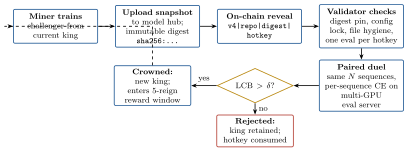
One way to view the process is as evolution under an extremely strict selection criterion: a new model receives no credit for the effort invested in training it; it must actually outperform the best known version.
This process differs from conventional data- or model-parallel training. Miners do not jointly compute an optimization step, exchange gradients, or average parameters. Coordination occurs through checkpoint selection: every accepted model becomes a new starting point and a public signal about which training choices improved the current objective. The network rewards verified improvement rather than claimed accelerator time, token count, or training effort.
2.2 Fixed and free choices
The competition fixed the model architecture and the 2,048-token context window, the latter dictated by the requirements of the evaluation system. The fixed architecture and tokenizer are those of Quasar-10B [15], created by SILX AI; its attention mechanism combines Quasar continuous-time attention with gated linear attention [16]. It also defined the evaluation data mixture and acceptance threshold. Miners remained free to choose datasets, preprocessing, curricula, optimizers, hyperparameters, training duration, and hardware. This separation creates a distributed search over training strategies while keeping submitted checkpoints directly comparable.
The setup also creates dependencies. A challenger must outperform the current king, so the value of a training strategy depends on the incumbent and the current evaluation mixture. Improvements are sequential rather than independent, and the reported final model is the product of a lineage of accepted checkpoints.
2.3 Implementation safeguards
Several implementation details of the production validator matter for
interpreting the record. First, submissions are pinned to an immutable
content digest (an OCI sha256 manifest digest) committed on
chain before evaluation; the validator refuses mutable references, which
closes the time-of-check-to-time-of-use gap between commitment and
evaluation. Second, a config lock requires an exact match of
the architecture string and of structural configuration keys
(vocabulary, hidden size, layer and head counts, rotary-embedding
parameters) against the incumbent; custom modeling code is admitted only
if byte-identical to the king’s own files. Third, each hotkey
registration is granted exactly one evaluation, and each model
repository is evaluated at most once, which removes replay and
resubmission-until-lucky strategies at the intake layer; a miner who
wants another attempt must register (and pay for) a fresh identity.
Fourth, the validator refuses to start unless commit-reveal weight
setting is enabled on the subnet, as encrypted weight commitments are
the load-bearing defense against weight-copying validators. Finally,
because copying the public king is the cheapest possible “training”
strategy, the validator fingerprints challenger tensors against known
checkpoints and compares upload timestamps across hosting backends; a
challenger whose weights are identical to an earlier upload is displaced
in favor of the earlier submitter without an evaluation. Model-copying
attempts were in fact observed during the competition.
Duels execute on a remote eight-GPU evaluation server that caches the incumbent king across duels, streams progress to the validator over server-sent events, and enforces a hard 30-minute wall-clock budget per evaluation. In the retained public record, the median completed duel took 1,063 seconds (\(\approx\)17.7 minutes) end to end, during which both models scored up to 25,000 sequences of 2,048 tokens each (\(\approx\)51M tokens per side).
3 Statistical Checkpoint Selection
3.1 Paired per-sequence loss
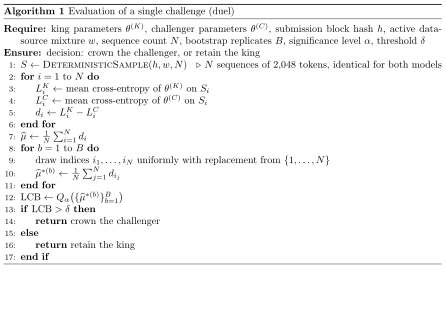
The king and challenger are evaluated on the same \(N\) sequences, each containing 2,048 tokens. Let \(L_i^{K}\) and \(L_i^{C}\) be their respective mean cross-entropy losses on sequence \(i\). Define the challenger’s paired advantage as \[d_i = L_i^{K}-L_i^{C}.\] A positive \(d_i\) indicates that the challenger assigns higher likelihood to the observed tokens. The sample mean advantage is \[\widehat{\mu}=\frac{1}{N}\sum_{i=1}^{N}d_i.\] Pairing removes variation caused by evaluating the two models on different examples and makes the statistical test directly sensitive to their loss difference.
3.2 Bootstrap lower confidence bound
Mean improvement alone is insufficient for promotion. The validator applies a percentile bootstrap [3] to the paired advantages, drawing \(B=10{,}000\) bootstrap samples of the sequence indices with replacement. For replicate \(b\), it computes \[\widehat{\mu}^{*(b)} = \frac{1}{N}\sum_{j=1}^{N}d_{i_j^{(b)}}, \qquad b=1,\ldots,B.\] The lower confidence bound is the empirical \(\alpha\)-quantile of the bootstrap distribution, \[\operatorname{LCB}=Q_{\alpha}\!\left(\widehat{\mu}^{*}\right), \qquad \alpha=0.001.\] The challenger is crowned if \[\operatorname{LCB}>\delta, \qquad \delta=0.0015,\] using the default values reported for the competition. Thus promotion requires both evidence of positive mean improvement and a minimum effect size. The strict quantile reduces sensitivity to noisy, marginal wins, although repeated adaptive submissions still warrant separate multiple-testing analysis. Algorithm 1 summarizes the procedure, and Table 1 consolidates the parameters that govern it.
| Symbol | Meaning | Value |
|---|---|---|
| — | Evaluation sequence length | 2,048 tokens |
| \(N\) | Evaluation sequences per duel | global hyperparameter (up to 25,000) |
| \(B\) | Bootstrap replicates | 10,000 |
| \(\alpha\) | Significance level of the LCB | 0.001 |
| \(\delta\) | Minimum required advantage | 0.0015 |
| — | Reward window (kings receiving emissions) | 5 |
| — | Incentive share per model in the window | 20% |
3.3 Evaluation-sample selection
Evaluation sequences are selected algorithmically from the submission block hash and the active data-source mixture. The submitting miner does not select the examples, and both models receive identical sequences. This design limits opportunities for favorable sample selection. It does not by itself rule out training–evaluation overlap, benchmark contamination, or strategic adaptation to a publicly known data distribution; these require independent audits.
3.4 Selection in practice
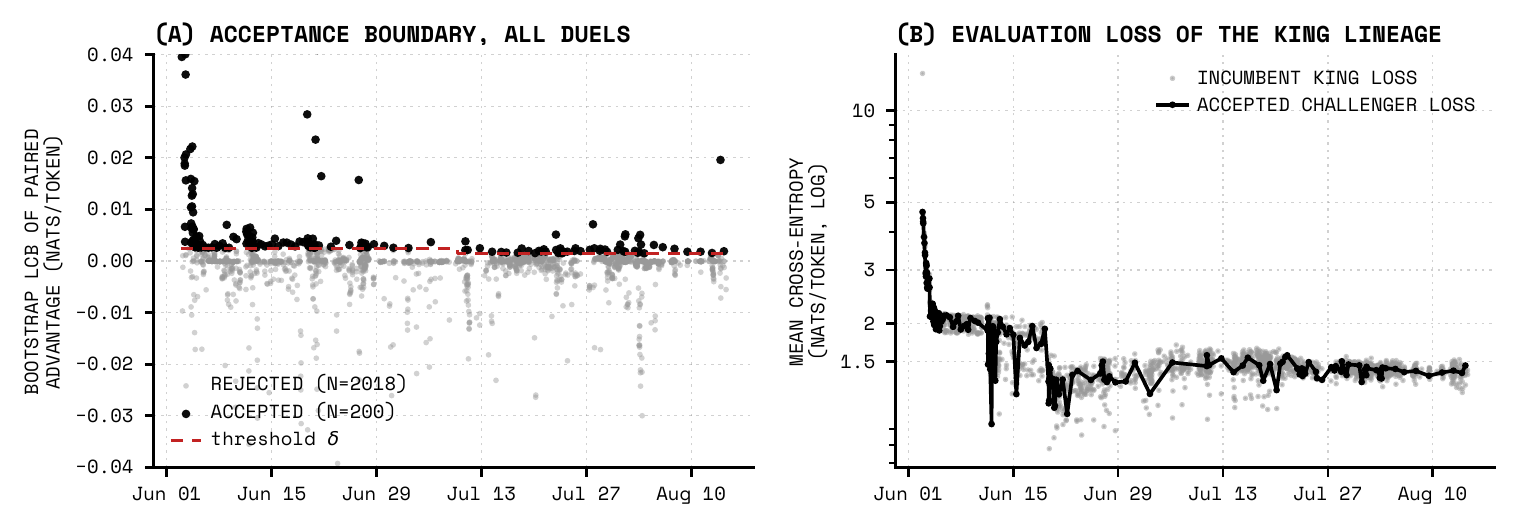
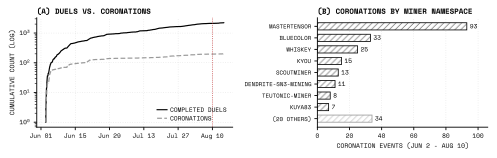
Figure 2 shows every completed duel retained in the public validator record at the time of writing: 2,218 records spanning June 2 to August 14, of which 2,117 fall on or before the August 10 report cutoff (98% of the 2,163 completed duels; the rolling history has since discarded a small number of the earliest events). Three properties of the mechanism are visible directly in the data. First, selection is strict: only 196 of the 2,117 retained duels (9.3%) cleared the acceptance boundary, and the cloud of rejected challengers sits overwhelmingly below the threshold line rather than just under it, indicating that most rejected challengers were not near-misses. Second, the acceptance margin is a live control surface: \(\delta\) was 0.0025 for the first seven weeks and was lowered to 0.0015 on July 21, and the evaluation-sample count was raised twice, reaching \(N=25{,}000\) from July 24. Third, the incumbent’s evaluation loss (Figure 2b) falls as a staircase of small accepted improvements punctuated by occasional larger drops, with visible level shifts when the evaluation mixture itself was reweighted.
In addition to the completed duels, roughly one thousand further submissions in the retained window failed pre-duel validation (missing or unreachable digests, malformed configurations, ownership-token mismatches) and were rejected without consuming evaluation compute.
4 Incentives and Global Control
4.1 Five-checkpoint reward window
Subnet incentives are allocated to the current king and up to four preceding kings whose hotkeys remain registered. When all five are present, each receives 20% of the allocated weight. If a historical king leaves the metagraph, shares are renormalized among the eligible checkpoints. A successful miner therefore continues receiving rewards for as many as four subsequent dethronements.
This mechanism softens a purely winner-takes-all contest while preserving a high entry threshold: a model enters the reward window only by becoming king. It also values checkpoints as steps in a lineage, rather than treating them as worthless immediately after a small subsequent improvement. The design may, however, favor frequent incremental coronations or strategic identities; the extent of such behavior is not quantified in the available competition record.
4.2 Global hyperparameters
Although miners control local training, validators can steer the global objective through the acceptance margin \(\delta\), evaluation-sample count, and dataset weights. Sixteen configuration updates were made during the competition: 15 changes to dataset configuration, one change to \(\delta\), and two changes to the evaluation-sample count (some updates changed more than one quantity). This creates a two-level optimization process: miners search locally for better checkpoints, while the subnet adjusts which improvements count as globally valuable. Both levers are directly visible in the duel record (Figure 2).
5 Experimental Record
5.1 Competition scale and trajectory
Table 2 summarizes the run. The initial randomly initialized model averaged 30.56% on the reported benchmark aggregate. Within seven days, the score reached 56.48%, a gain of 25.92 percentage points and more than 80% of the total improvement to the later peak. Training emphasis shifted toward mathematics and reasoning in the second half of June; performance subsequently plateaued near 61–62% during July. King #191 reached the peak of 62.28% on August 1. The final configuration point was recorded on August 10.
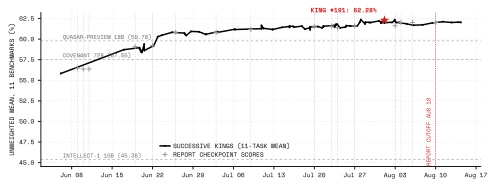
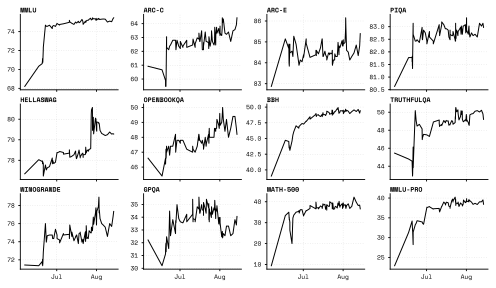
Figure 3 plots the full benchmark trajectory of the king lineage: the unweighted 11-task mean of every king for which the daily benchmark service (built on the lm-evaluation-harness [4]) completed a full evaluation (94 checkpoints between June 6 and August 14). The earliest benchmarked king, four days into the competition, already averaged 55.8%, confirming that most of the headline gain was realized in the opening week; the remaining ten weeks added roughly six points through many small accepted improvements. The lineage crossed the reported aggregate of Covenant 72B in mid-June and that of Quasar-Preview 18B by early July.
5.2 Participation
The retained duel record contains submissions from 73 distinct coldkeys publishing under 22 distinct repository namespaces. Figure 4 shows the flow of duels and coronations over time and the concentration of coronation events across miner identities. Participation is broad at the duel level but concentrated at the coronation level: the most successful namespace accounts for roughly 39% of recorded coronation events, and the top three for about 63%. This is consistent with the incentive analysis above: the reward window pays only kings, so persistent, well-resourced miners dominate the accepted lineage while a long tail of participants probes the boundary.
| Quantity | Value |
|---|---|
| Duration | 70 days |
| Competition dates | Jun. 2–Aug. 10, 2026 |
| Architecture | Quasar-10B |
| Parameter count | 10B |
| Context length | 2,048 tokens |
| Completed duels | 2,163 |
| Successful coronations | 203 |
| Datasets used | 12 |
| Hyperparameter updates | 16 |
| Acceptance rate | 9.3% |
| Median duel wall time | 17.7 min |
| Distinct submitting coldkeys | 73 |
| Best checkpoint | King #191 |
| Date of best checkpoint | Aug. 1, 2026 |
| Best 11-task mean | 62.28% |
5.3 Data mixtures
Across the run, 12 named datasets were active for different durations (Table 3). The evaluation corpus was reported to contain more than four trillion tokens, with samples drawn from the active mixture; all sources were pre-tokenized with the Quasar-10B tokenizer [15]. Among the sources, Quasar-SN3 is a dataset published by SILX AI [18] and was active in the mixture for 29 days. Dataset introduction, removal, and reweighting were used to redirect training toward desired capabilities. Active-day counts describe inclusion in the global objective, not the number of tokens consumed by individual miners.
Table 4 reports the final evaluation mixture as published in the validator’s dataset manifest (August 13, 2026): 11 enabled sources totalling 4.24 trillion pre-tokenized evaluation tokens, with per-source sampling weights. General web text (FineWeb-Edu [10]) retains the largest single weight, but mathematics and reasoning sources jointly account for roughly half of the sampling mass, reflecting the mid-competition steer toward those capabilities.
| Dataset | Days | Dataset | Days |
|---|---|---|---|
| FineWeb-Edu | 70 | AutoMathText-V2 | 62 |
| UltraData-Math / L3 | 62 | Quasar-SN3 | 29 |
| Nemotron Specialized v1.1 | 36 | Nemotron Specialized v1.2 | 53 |
| Nemotron-CC-Math | 46 | OpenThoughts3-1.2M | 46 |
| peS2o-v3 | 31 | OpenMathReasoning | 22 |
| Dendrite-Synth v1/v2/v3 | 20 | Cosmopedia | 20 |
| Source | Weight | Tokens |
|---|---|---|
| FineWeb-Edu | 0.25 | 1.58T |
| AutoMathText-V2 | 0.19 | 2.25T |
| OpenMathReasoning | 0.10 | 39.2B |
| Dolma3 LongMino (8k pool) | 0.10 | 70.6B |
| UltraData-Math-L3 | 0.08 | 78.0B |
| OpenThoughts3-1.2M | 0.08 | 18.7B |
| peS2o-v3 | 0.06 | 79.6B |
| Cosmopedia (WikiHow/stories) | 0.06 | 2.8B |
| Nemotron-CC-Math v1 (4+, MIND) | 0.04 | 76.0B |
| Nemotron Specialized v1.2 | 0.03 | 43.6B |
| Dendrite-Synth | 0.01 | 0.6B |
| Total | 1.00 | 4.24T |
6 Downstream Evaluation
6.1 Evaluation protocol
Table 5 states the protocol under which the Teutonic-I 10B scores
were produced: nine of the 11 shared benchmarks are evaluated zero-shot,
BBH uses three in-context examples, and MATH-500 uses four.
acc is accuracy from the log-likelihood assigned to each
answer option; acc_norm normalizes that log-likelihood by
option length so longer options are not systematically penalized;
exact_match is string-level agreement of the extracted
final answer. For comparison models, the scores in Table 6 are the best
figures published by their respective authors, or measurements under
this protocol where none were published. Externally reported scores were
not necessarily produced under this protocol; in particular, the
settings behind Quasar-Preview 18B’s MATH-500 score are not
documented.
| Benchmark | Shots | Metric | Benchmark | Shots | Metric |
|---|---|---|---|---|---|
| MMLU | 0 | acc |
OpenBookQA | 0 | acc_norm |
| ARC-C | 0 | acc_norm |
BBH | 3 | acc_norm |
| ARC-E | 0 | acc_norm |
TruthfulQA | 0 | acc |
| PIQA | 0 | acc_norm |
WinoGrande | 0 | acc |
| HellaSwag | 0 | acc_norm |
GPQA | 0 | acc_norm |
| MATH-500 | 4 | exact_match |
6.2 Shared-benchmark comparison
Table 6 compares reported scores on 11 benchmarks available for all six models: MMLU [5], ARC-C and ARC-E [2], PIQA [1], HellaSwag [24], OpenBookQA [8], BBH [19], TruthfulQA [7], WinoGrande [14], GPQA [13], and MATH-500 [6]. The comparison set spans other decentralized training initiatives, including INTELLECT-1 10B [11], Psyche Consilience 40B [9], and SILX AI’s Quasar 10B and Quasar-Preview 18B [15,17], the latter two developed on Bittensor Subnet 24. The final row is an unweighted arithmetic mean; it does not account for benchmark difficulty, test-set size, uncertainty, or potential differences in evaluation harnesses. On this aggregate, Teutonic-I 10B scores 62.28%, ahead of Quasar-Preview 18B at 59.78% and Covenant 72B at 57.55%. It leads 8 of 11 rows. Quasar-Preview leads PIQA and MATH-500, while Covenant leads HellaSwag.
| Benchmark | Teutonic-I 10B | Quasar 10B | Quasar-Preview 18B | INTELLECT-1 10B | Psyche 40B | Covenant 72B |
|---|---|---|---|---|---|---|
| MMLU | 75.29 | 49.63 | 60.87 | 32.69 | 24.23 | 67.11 |
| ARC-C | 63.82 | 41.89 | 63.40 | 44.80 | 31.14 | 56.83 |
| ARC-E | 84.97 | 62.96 | 82.45 | 71.76 | 55.77 | 80.93 |
| PIQA | 82.81 | 69.91 | 83.30 | 77.73 | 76.12 | 81.56 |
| HellaSwag | 79.42 | 62.37 | 73.07 | 70.26 | 63.67 | 80.61 |
| OpenBookQA | 49.00 | 35.40 | 46.40 | 43.80 | 35.20 | 44.00 |
| BBH | 49.51 | 31.26 | 38.10 | 32.93 | 30.50 | 45.96 |
| TruthfulQA | 49.58 | 41.01 | 41.70 | 35.45 | 37.90 | 49.41 |
| WinoGrande | 77.35 | 56.27 | 67.56 | 63.30 | 56.99 | 75.85 |
| GPQA | 33.98 | 25.84 | 29.28 | 25.84 | 24.66 | 30.03 |
| MATH-500 | 39.40 | 0.00 | 71.40 | 1.00 | 0.20 | 20.80 |
| Unweighted mean | 62.28 | 43.32 | 59.78 | 45.38 | 39.67 | 57.55 |
The largest notable advantage over Covenant is on MMLU, where Teutonic-I 10B scores 75.29% versus 67.11%. Teutonic-I also leads the comparison on both ARC tasks, BBH, TruthfulQA, WinoGrande, GPQA, and OpenBookQA. Its clearest relative weakness is MATH-500: 39.40% compared with 71.40% for Quasar-Preview. This heterogeneity is obscured by the mean and argues against interpreting the aggregate as a complete model ranking.
On the separately reported MMLU-Pro [23] evaluation (five in-context
examples, scored with exact_match after a dedicated
answer-extraction filter), Teutonic-I 10B achieved 39.84%, versus 33.20%
for Quasar-Preview 18B. Because comparable MMLU-Pro scores were not
provided for all models, this result is excluded from the 11-task
mean.
6.3 Per-benchmark dynamics
Figure 5 decomposes the aggregate trajectory into its 12 constituent benchmarks. The dynamics are heterogeneous. Knowledge- and reading-oriented tasks (MMLU, ARC-E, PIQA, HellaSwag, WinoGrande) rose quickly and then drifted upward slowly, closely tracking the pretraining-loss staircase of Figure 2b. MATH-500 instead moved in discrete jumps aligned with the introduction and reweighting of mathematics corpora in the global mixture, from near zero to just under 40%. TruthfulQA and GPQA improved modestly and noisily, as expected for tasks weakly coupled to next-token loss on the evaluation mixture. This decomposition illustrates both the strength and the limit of loss-based selection: capabilities well represented in the evaluation mixture improve steadily, while others move only when the mixture is steered toward them.
6.4 Interpretation
The comparison demonstrates that a 10B checkpoint produced by the SN3 process can exceed several larger models on this particular suite and score aggregation. It does not demonstrate that the model is uniformly superior, more compute efficient, or more capable in deployment. Parameter count is only one factor; training tokens, data quality, contamination, optimizer state, total network compute, and evaluation implementation may all affect the outcome. A stronger study would reevaluate every checkpoint in one harness, report confidence intervals, include contamination checks, and normalize by total training FLOPs and monetary cost.
7 Discussion
Decentralization as search.
SN3 decentralizes experiment selection rather than a single gradient calculation. This may broaden the search over curricula and optimization recipes, allow specialized participants to contribute independently, and make progress measurable through an auditable incumbent. Sequential inheritance also lets later miners build on earlier improvements.
Selection pressure.
The combination of paired evaluation, a low bootstrap quantile, and a positive margin discourages noisy replacement. Yet a fixed objective can invite over-specialization to its data mixture. Changes to global dataset weights can counter stagnation, but they also make the target nonstationary and place substantial influence in the hands of whoever controls those weights.
Compute efficiency.
The system may avoid committing all resources to one centrally chosen recipe, but rejected challengers consume compute without directly changing the model. Without miner-level token and hardware logs, total compute efficiency cannot be compared with centralized pretraining. The relevant question is not merely whether the final model is small, but how much aggregate computation and data were required to discover it. The validator-side cost is measurable: at a median of 17.7 minutes per duel on one eight-GPU server, the full 2,163-duel record represents roughly 640 GPU-hours of evaluation compute, small relative to any plausible estimate of the miners’ aggregate training compute.
Reproducibility.
Deterministic sample selection and explicit promotion rules make individual duels more reproducible than subjective model claims. End-to-end reproduction still requires versioned checkpoints, exact data-mixture snapshots, evaluation code, random seeds, tokenizer details, miner training disclosures, and a record of every global configuration change.
8 Limitations and Broader Impacts
This report is based on the competition statistics and benchmark values made available by the project. We did not independently rerun the benchmarks or verify every checkpoint lineage. The comparisons may mix evaluation harnesses or prompting conventions, and no uncertainty estimates are available for the downstream scores. The unweighted mean treats all benchmarks equally and can be strongly affected by outliers such as MATH-500. There is no matched centralized baseline trained with the same architecture, data access, token budget, and aggregate compute, so causal claims about the benefit of decentralization are not supported. The figures in this paper are computed from the public validator record, which is a rolling window: a small fraction of the earliest duel events had already been discarded at the time of analysis, and the benchmark index records coronation events rather than deduplicated reigns.
Open competition can broaden participation in model development and create transparent, performance-based incentives. Conversely, financial rewards may encourage benchmark gaming, checkpoint copying, hidden data use, or duplicated compute. Data provenance, licensing, privacy, model safety, and the energy cost of unsuccessful challengers require governance beyond loss-based selection. Future competitions should include provenance attestations, contamination audits, compute reporting, safety evaluations, and mechanisms for detecting copied or minimally modified submissions.
The subnet operators state that the next competition will target substantially larger models, potentially around 100B parameters, and that mechanisms developed during this run — synthetic-dataset generation and autonomous selection of pretraining hyperparameters among them — will be documented separately.
9 Conclusion
The Teutonic Subnet 3 competition produced a strong 10B language model through 70 days of sequential, decentralized checkpoint improvement. A statistically conservative duel mechanism converted independent training experiments into a shared model lineage, yielding 203 accepted improvements from 2,163 completed challenges. The best checkpoint averaged 62.28% over 11 reported shared benchmarks and ranked first on 8, exceeding the reported aggregate of several models with more parameters. The result is evidence that competitive checkpoint selection is a viable coordination mechanism for pretraining research. Establishing its efficiency and general advantage over centralized training will require controlled baselines, standardized reevaluation, aggregate-compute accounting, and stronger data and checkpoint audits.
Acknowledgments
The competition builds directly on work by the Quasar team at SILX AI (Bittensor Subnet 24): the fixed model architecture and tokenizer are those of Quasar-10B [15], whose hybrid attention design is described in the quasar-attention repository [16], and the Quasar-SN3 dataset [18] was part of the evaluation mixture. We thank SILX AI for releasing these artifacts openly.
Declaration of Generative AI Use
The design and operation of the subnet, the pretraining competition, and all measurements and benchmark results are the work of the subnet’s operators and participants. A generative AI assistant was used in the preparation of this manuscript: to structure and rewrite the prose in an academic register, to extract and analyze the public validator record, to generate the figures from that data, and to typeset the document in LaTeX.
Reproducibility Statement
The system implementation is available through the Teutonic
repository, the released model weights are hosted on Hugging Face (https://huggingface.co/dendriteholdings/Teutonic-I), and
project information and further artifacts are linked below. A complete
release should preserve all evaluated checkpoints, block-derived sample
identifiers, data-mixture configurations, validator code, and
benchmark-harness versions. The headline numerical values in this paper
are transcribed from the supplied SN3 technical report. Figures 2–5 and
Tables 2 (acceptance rate, wall time, participation rows) and 4 are
computed directly from the public validator artifacts as retrieved on
August 14, 2026: the live dashboard state (dashboard.json),
the all-kings benchmark index
(king-benchmark-daily/all-kings/index.json), and the
dataset manifest (dataset/all-datasets.manifest.json), all
served from the project’s public object store. The extraction and
plotting script is included alongside this manuscript.
References
[1] Y. Bisk, R. Zellers, R. Le Bras, J. Gao, and Y. Choi. PIQA: Reasoning about physical commonsense in natural language. In AAAI, 2020.
[2] P. Clark, I. Cowhey, O. Etzioni, T. Khot, A. Sabharwal, C. Schoenick, and O. Tafjord. Think you have solved question answering? Try ARC, the AI2 Reasoning Challenge. arXiv:1803.05457, 2018.
[3] B. Efron. Bootstrap methods: Another look at the jackknife. The Annals of Statistics, 7(1):1–26, 1979.
[4] L. Gao, J. Tow, B. Abbasi, et al. A framework for few-shot language model evaluation. Zenodo, https://doi.org/10.5281/zenodo.5371628, 2023.
[5] D. Hendrycks, C. Burns, S. Basart, A. Zou, M. Mazeika, D. Song, and J. Steinhardt. Measuring massive multitask language understanding. In ICLR, 2021.
[6] D. Hendrycks, C. Burns, S. Kadavath, A. Arora, S. Basart, E. Tang, D. Song, and J. Steinhardt. Measuring mathematical problem solving with the MATH dataset. In NeurIPS Datasets and Benchmarks, 2021. MATH-500 denotes the 500-problem subset introduced by Lightman et al., Let’s Verify Step by Step, 2023.
[7] S. Lin, J. Hilton, and O. Evans. TruthfulQA: Measuring how models mimic human falsehoods. In ACL, 2022.
[8] T. Mihaylov, P. Clark, T. Khot, and A. Sabharwal. Can a suit of armor conduct electricity? A new dataset for open book question answering. In EMNLP, 2018.
[9] Nous Research. Psyche: a decentralized training network. https://nousresearch.com/nous-psyche/, 2025.
[10] G. Penedo, H. Kydlı́ček, L. Ben allal, A. Lozhkov, M. Mitchell, C. Raffel, L. Von Werra, and T. Wolf. The FineWeb datasets: Decanting the web for the finest text data at scale. In NeurIPS Datasets and Benchmarks, 2024.
[11] Prime Intellect. INTELLECT-1 technical report. arXiv:2412.01152, 2024.
[12] Y. Rao. Bittensor: A peer-to-peer intelligence market. Bittensor whitepaper, https://www.bittensor.com/whitepaper.
[13] D. Rein, B. L. Hou, A. C. Stickland, J. Petty, R. Y. Pang, J. Dirani, J. Michael, and S. R. Bowman. GPQA: A graduate-level Google-proof Q&A benchmark. arXiv:2311.12022, 2023.
[14] K. Sakaguchi, R. Le Bras, C. Bhagavatula, and Y. Choi. WinoGrande: An adversarial Winograd schema challenge at scale. In AAAI, 2020.
[15] SILX AI. Quasar-10B model card. https://huggingface.co/silx-ai/Quasar-10B, 2026.
[16] SILX AI. Quasar attention: continuous-time linear attention for long-context language models. https://github.com/SILX-LABS/quasar-attention, 2026.
[17] SILX AI. Quasar-Preview model card. https://huggingface.co/silx-ai/Quasar-Preview, 2026.
[18] SILX AI. Quasar-SN3 dataset. https://huggingface.co/datasets/silx-ai/Quasar-SN3, 2026.
[19] M. Suzgun, N. Scales, N. Schärli, S. Gehrmann, Y. Tay, H. W. Chung, A. Chowdhery, Q. V. Le, E. H. Chi, D. Zhou, and J. Wei. Challenging BIG-Bench tasks and whether chain-of-thought can solve them. In Findings of ACL, 2023.
[20] Teutonic contributors. Teutonic: decentralized model pretraining infrastructure. https://github.com/unarbos/teutonic, 2026.
[21] Teutonic. Teutonic project website. https://teutonic.ai/, 2026.
[22] Teutonic contributors. Teutonic-I 10B model weights. https://huggingface.co/dendriteholdings/Teutonic-I, 2026.
[23] Y. Wang, X. Ma, G. Zhang, Y. Ni, A. Chandra, S. Guo, W. Ren, A. Arulraj, X. He, Z. Jiang, et al. MMLU-Pro: A more robust and challenging multi-task language understanding benchmark. In NeurIPS Datasets and Benchmarks, 2024.
[24] R. Zellers, A. Holtzman, Y. Bisk, A. Farhadi, and Y. Choi. HellaSwag: Can a machine really finish your sentence? In ACL, 2019.
Appendix A: Configuration-checkpoint scores
Table 7 lists the average benchmark score of the reigning king at each configuration checkpoint, as published in the technical report. Each score was computed for the final king preceding a given hyperparameter update; when the corresponding king checkpoint was unavailable, the closest matching model was used instead. The June 2 entry is the randomly initialized starting model, and the August 1 entry is king #191. These are the green crosses overlaid on Figure 3.
| Date | Score | Date | Score |
|---|---|---|---|
| 02.06 | 30.56 | 20.07 | 61.56 |
| 09.06 | 56.48 | 23.07 | 61.58 |
| 10.06 | 56.37 | 24.07 | 61.37 |
| 11.06 | 56.37 | 27.07 | 61.61 |
| 19.06 | 59.09 | 01.08 | 62.28 |
| 22.06 | 59.21 | 03.08 | 61.62 |
| 26.06 | 60.82 | 04.08 | 62.02 |
| 03.07 | 60.81 | 06.08 | 62.02 |
| 09.07 | 61.16 | 10.08 | 62.02 |